


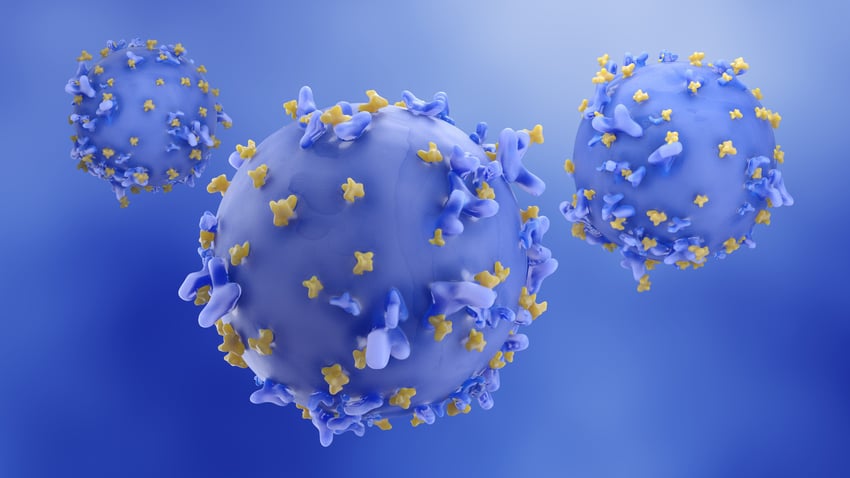
Generate Biomedicines' CEO has hailed the “huge opportunity” offered by AI tools after the Flagship-founded company used Anthropic's Claude platform to reduce the size of CAR-T cell engines.
When scientists assemble CAR-T cell therapies, it's similar to building an actual car. The intracellular domains (or engines) are arguably the most important aspect, as they control T-cell activation, cytotoxicity, proliferation and long-term survival. Usually, CAR-T cells are built using an ICD with a CD3ζ component and a 4-1BB component, with the former acting as the T-cell activator and the latter having a costimulatory role to promote T-cell proliferation and survival.
With the help of Claude, Generate was able to produce a version of an ICD that was 70% shorter than its previous models, despite offering increased CAR surface expression and longer-lasting tumor-killing abilities across multiple delivery methods. The Massachusetts-based biotech told Fierce that it aims to leverage this technology to tackle solid tumors, an area where CAR-Ts have struggled to prove their worth.
“We think this technology has a huge opportunity to hopefully enable a range of applications in both solid tumors, potentially hematological malignancies, and immunology,” Generate CEO Mike Nally told Fierce.
Kaggen Ausma, vice president of application development at Generate, also explained to Fierce that “shorter seems to be better, and that is very true for in vivo CAR T.”
In order to develop the shorter ICD, scientists at Generate paired their own protein-generation models with Claude’s AI agents to speed up the process of discovering sequences for the ICDs. Once Claude suggested a sequence, Generate’s biology experts would provide feedback to the AI agents.
“It's this beautiful trifecta of protein generation models, biology models with the [large language model] agents helping really speed that up, and really thoughtful experts who make sure that the cycle is producing really good answers,” Ausma said.
Generate is currently taking this innovation into animal models, with data to hopefully come by the end of this year, according to Nally.
“We think there's wide-ranging implications for this sort of technology, and hopefully an ability to improve the lives of many patients with very serious disease,” the CEO added.
CAR-T cell therapy has been quite successful in blood cancers, most notably with Novartis’ Kymriah, Gilead’s Yescarta and Tecartus, Bristol Myers Squibb’s Breyanzi and Abecma, and Legend’s Carvykti. But it's been tougher going against solid tumors, where CAR-Ts have hit some difficulties when it comes to penetrating these tumors and then quick T-cell exhaustion if the therapy reaches the cancer. There have also been challenges around heterogeneity.
Using Claude is a natural step for Generate, which was founded by Flagship Pioneering in 2018 with a mission to use machine learning and generative AI to design protein therapeutics. Generate went public with a $400 million IPO in February to fund a pair of phase 3 asthma trials for its anti-TSLP antibody GB-0895.
Claude's developer Anthropic is preparing for its own IPO—albeit on a totally different scale. The AI giant has been planning a public listing that could top $100 billion, with the company's drug development plans forming a key plank of the prospectus. In its filing last week, Anthropic explained how it is delving deeper into medicines R&D by building its own molecular biology lab and investing in research that could eventually produce drug candidates.
The company envisions AI systems that could match or exceed the capabilities of top human experts across scientific disciplines, perform complex tasks autonomously and operate laboratory equipment and robotic systems, according to the filing. Anthropic also pointed to the Generate collaboration as one of the examples of how the AI company's life sciences team is "working to accelerate curing disease."
Anthropic has already made inroads into the drug development industry through partnerships with pharma giants such as Novo Nordisk and Bristol Myers Squibb, while bringing Novartis CEO Vas Narasimhan onto its board of directors in April.
The role of AI in drug development is one of the hot topics being discussed at Fierce Biotech's high-impact event in London this month. Find out more information and register by clicking on the banner below:
